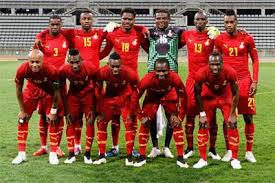
Ghana blackstars,★


- “Unfolding the Legends: The Evolution of Football Through the Ages”
- “From Kicking Skulls to World Cups: Tracing the Fascinating Origins of Football”
- “The Game That Stole Our Hearts: The Untold Stories Behind Football’s Global Craze”
- “The Rise and Fall: How a Simple Ball Revolutionized the World – A Football History”
- “Meet the Trendsetters: Football Pioneers and the Game-Changing Moments That Shaped the Sport”
- “Football Frenzy: Unraveling the Secrets of the Beautiful Game’s Famous Rivalries”
- “Kickoff to Worldwide Pandemonium: How Football Conquered Nations and United Fans”
- “When the World Held Its Breath: Football’s Dramatic Journey to the Modern Era”
- “Beyond the Field: Football’s Impact on Society, Culture, and the World Economy”
- “Play to Pause: The Unexpected Reasons Why Football Came to a Halt Throughout History”
- “From Leather Balls to High-Tech Cleats: Dive into the Striking Evolution of Football!”
- “Unveiling the Untold Legends: ivantettehhistories takes you on a Journey Through Football History”
- “Game Changers All the Way: Discover the Pioneers Who Transformed Football Forever”
- “Behind the Roar of the Crowd: Exploring the Fascinating Origins of Football Chants and Cheers”
- “Revisiting the Glory Days: Relive the Most Iconic Matches in Football History with ivantettehhistories”
- “Beyond the Pitch: The Social Impact of Football Throughout the Ages”
- “Innovations and Inventions: How Football Equipment Revolutionized the Game We Love”
- “Stepping onto Hallowed Ground: Unearthing the Most Historic Football Stadiums Worldwide”
- “Revolutionary Tactics and Formations: Uncover How Football Strategy Has Evolved”
- “The Legends We Cherish: ivantettehhistories Shines a Spotlight on Football’s Greatest Icons”
The Ghana national football team represents Ghana in men’s international football and has done so since the 1950s. The team consists of twenty players including the technical team. The team is nicknamed the Black Stars after the Black Star of Africa in the flag of Ghana.
It is governed by the Ghana Football Association, the governing body for football in Ghana and the oldest football association in Africa (founded in 1920). Prior to 1957, the team played as the Gold Coast, The team represents both FIFA and the Confederation of African Football (CAF).
Although the team qualified for the senior FIFA World Cup for the first time in 2006, they had qualified for four Olympic Games Football Tournaments when the tournament was still a full senior national team competition; their best achievement was the third position at the 1992 Summer Olympics. The team has won the Africa Cup of Nations four times (in 1963, 1965, 1978, and 1982) and has been runner-up five times (in 1968, 1970, 1992, 2010, and 2015).
After going through 2005 unbeaten, the Ghana national football team won the FIFA Best Mover of the Year Award and reached the second round of the 2006 FIFA World Cup. At the 2010 FIFA World Cup in South Africa, they became only the third African team to reach the World Cup quarter-finals, and in 2014 they competed in their third.
The Gold Coast Football Association was founded in 1920, succeeded by the Ghana Football Association (GFA) in 1957, which was affiliated with the Confederation of African Football and FIFA the following year.
On 19 August 1962 at the Accra Sports Stadium, the Black Stars played Spanish giants Real Madrid, who were at the time Spanish champions, former European champions and intercontinental champions, and drew 3–3.
Charles Kumi Gyamfi became coach in 1961, and the Black Stars won successive African Cup of Nations titles, in 1963 and 1965, and achieved their record win, 13–2 away to Kenya, shortly after the second of these. They also reached the final of the tournament in 1968 and 1970, losing 1–0 on each occasion, to DR Congo and Sudan respectively. Their domination of this tournament earned the Black Stars team the nicknames “the Black Stars of West Africa” and “the Black Stars of Africa” in the 1960s.
The team had no success in FIFA World Cup qualification during this era and failed to qualify for three successive African Cup of Nations in the 1970s, but qualified for the Olympic Games football tournaments, becoming the first team from sub-Saharan Africa to qualify for the Games, and reaching the quarter-finals in 1964 and withdrawing on political grounds in 1976 later winning the 1982 African cup of nations.
After three failures to reach the tournament final, the 1992 African Cup of Nations saw the Black Stars finish. Prior to the year 2000, disharmony among the squad which eventually led to parliamentary and executive intervention to settle issues between two squad members, Abedi Pele and Anthony Yeboah in the late 1990s, may have played some part in the failure of the team to build on the successes of the national underage teams in the late 1990s, but a new generation of Black Stars players who went to the 2001 FIFA World Youth Championship final became the core of the team at the 2002 African Cup of Nations, and was undefeated for a year in 2005 and reached the finals of the 2006 FIFA World Cup, the first time the team had reached the global stage of the tournament.
The Black Stars started by succumbing to a 2–0 defeat to eventual champions Italy, but wins over the Czech Republic (2–0) and the United States (2–1) saw them through to the second round, where they lost 3–0 to Brazil.
In 2008, Ghana reached a high ranking of 14 according to the FIFA World Rankings. The Black Stars went on to secure a 100 per cent record in their qualification campaign, winning the group and becoming the first African team to qualify for the 2010 FIFA World Cup. In the final tournament, the team competed in Group D with Germany, Serbia and Australia.
Ghana reached the round of 16 where they played the United States, winning 2–1 in extra time to become the third African nation to reach the World Cup quarter-finals. The team then lost to Uruguay in a penalty shootout in the quarter-finals, having missed a penalty kick in extra time after a certain goal was prevented by Luis Suárez’s deliberate handball, who was then shown a red card for his actions.
In 2013 Ghana became the only team in Africa to reach four consecutive semi-finals of the CAF Africa Cup of Nations twice, from 1963 and 1970 and from 2008 and 2013.
Ghana was sufficiently highly ranked by FIFA to start their qualifying for the 2014 World Cup in the second round. They won the group, and in the following round qualified for the 2014 World Cup finals in November 2013, beating Egypt 7–3 on aggregate in a two-legged play-off. Ghana was drawn into Group G for the finals, where they faced Germany, Portugal, and the United States.
The World Cup finals ended up in disappointment as Ghana exited in the group stages with issues of poor planning and payment bonuses being blamed for the poor performance, although they did manage a 2–2 draw with Germany, who ended up winning the competition. They would be the only team to not lose to Germany in that tournament.
The black star is present on the Flag of Ghana and the national coat of arms in the centre of the national crest. Adopted following the independence of Ghana in 1957, the black star has always been included in its kits. The Black Sta rs’ kits were sponsored by Puma SE from 2005, with the deal ending in 2014.
The Black Star kit is used instead of the original gold, green, and red coloured football kit based on the colours of the Ghana national flag. The Black Stars have used an all-white and partly black football kit which was worn from the years 1957 to 1989 and again from 2006 until December 2014.
Between 1990 and 2006 the Ghana national three-team used the kit in the colours of the national flag of Ghana, with gold, green and red used extensively, as in the team’s crest and also known as the Pan-African colours. The gold with green and red kit concept and design was also used in the sixties and seventies, and designed with gold and green vertical stripes and red shoulders.
An all-black second kit was introduced in 2008 and in 2015, Black Stars’ gold-red-green coloured kit and the all-black coloured kit are to be reassigned to the position of 1st and 2nd kits following the induction of a brown with blue and gold coloured Black Stars 3rd kit in 2012.
The Ghana national football team’s football kit for the 2014 FIFA World Cup was ranked as the best kit of the tournament by BuzzFeed.
TALK TO US
IG:bigczarivan
📞:+233268547418
About the author
Refer to Home page…thank you
 ivantetteh'ssite.com